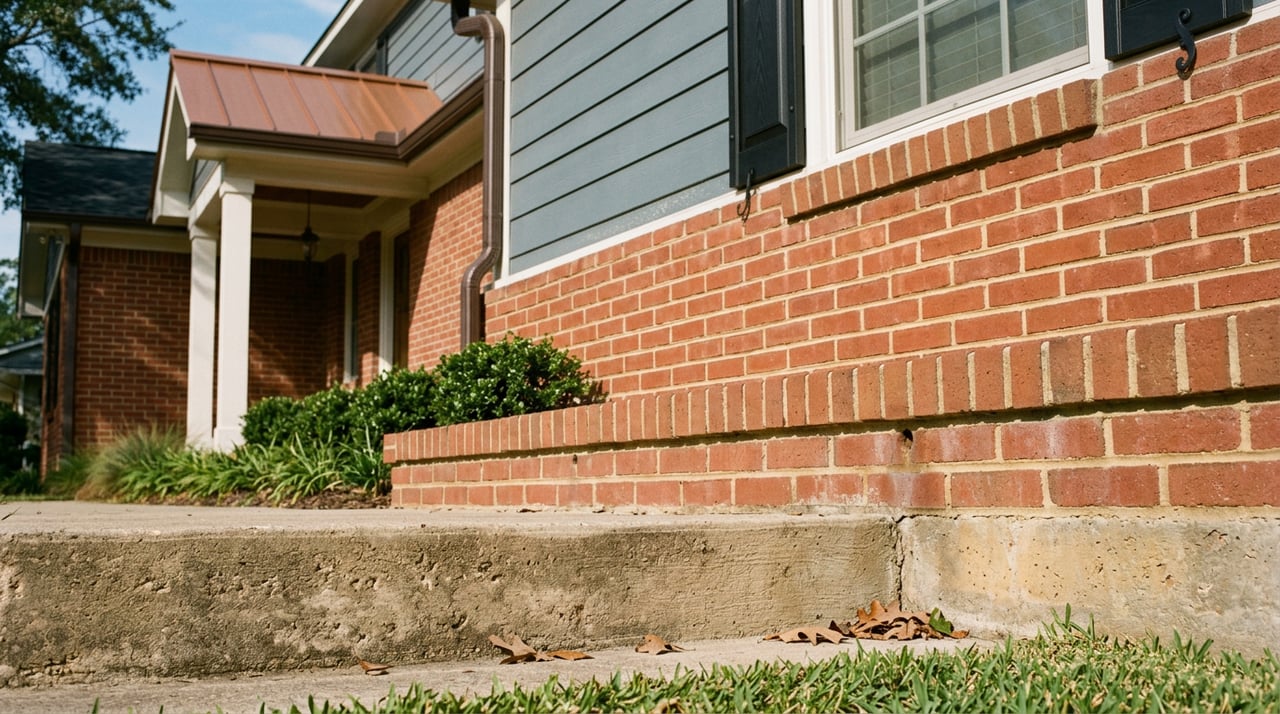
When Plumbing Leaks Can Affect Foundations in Baytown's Older Homes
September 10, 2026
September 10, 2026
If you are buying or selling a home in one of Baytown's older sections, an inspector is likely to hand you two separate findings: aging plastic supply lines behind the walls, and stair-step cracks near a door or window frame. Most people treat these as unrelated repair items to negotiate one at a time. They are not unrelated. In a home built on Baytown's clay soil, a failing pipe and a shifting foundation are often the same event, seen from two different angles. Understanding that connection changes how you read an inspection report, and it changes what a smart seller does before the report ever gets written.
Baytown as it exists today came together in 1948, when three separate communities, Goose Creek, Pelly, and Baytown proper, consolidated into a single city. Each retained its own identity for decades afterward, and each still shapes what you find on a walkthrough. Pelly's housing stock is dominated by homes built between 1940 and 1969, with a second wave through the late 1990s. Out toward Wooster, a rural community settled by families from Iowa in the 1890s, subsidence and hurricane damage reclaimed much of the original neighborhood, and ExxonMobil later purchased large stretches of what remained for a company greenbelt. Central Baytown and Goose Creek carry a similar mix of postwar construction and later infill.
That timeline matters for one specific reason: it tells you what is likely running through the walls.
Between 1978 and 1995, polybutylene, often called poly-B, was the standard supply line material across Houston-area subdivisions, including the ones built out during Baytown's mid-century growth and its later infill. Builders liked it because it was cheap and fast to install compared to copper. The problem surfaced later: chlorine and other oxidants in municipal water cause the pipe to become brittle from the inside, and it can fail without any visible warning. A section that looks fine during a walkthrough can split months after closing.
If you are touring a Baytown home built in that window, you can check for it yourself without any tools. Look at the exposed supply lines near the water heater, under kitchen and bathroom sinks, and at the valves behind toilets. Genuine polybutylene is usually a dull grey, though it occasionally shows up in silver, blue, or black on the main service line. The definitive marker is a printed code on the pipe itself, PB2110. A previous owner may have already swapped the visible sections under a sink while leaving the original piping inside the walls untouched, so a clean-looking connection at one fixture does not clear the rest of the house.
The financing consequence is real. Because poly-B has a documented failure history, some insurance carriers now decline to write a policy on a home that still has it, and others add an exclusion for water damage caused by the pipe itself. That can complicate a closing timeline in ways that have nothing to do with the sale price.
Baytown sits on expansive clay, largely from the Beaumont and Lissie formations that run along this stretch of the upper Texas Gulf Coast. Soil survey data for the 77520 zip code, drawn from the USDA's Web Soil Survey, classifies the local soil unit as having a Plasticity Index of 24, just under the threshold of 25 that structural guidelines treat as the line into higher-risk territory. In plain terms, this clay swells when it absorbs water and shrinks hard when it dries out, and Baytown's proximity to Galveston Bay and Cedar Bayou means that moisture cycle runs more often and more sharply here than it would inland.
The visible signs are familiar to anyone who has toured an older home in this part of Texas: diagonal cracks radiating from door and window corners, a door that suddenly won't latch, a floor that feels slightly sloped in one room. None of these are unusual on their own in a Gulf Coast home built before modern drainage standards became routine.
Here is the connection that most inspection checklists skip. A slab leak, meaning a broken or leaking pipe running beneath the concrete foundation, creates a concentrated pocket of saturation in the soil directly under that section of the house. Expansive clay reacts to that localized moisture the same way it reacts to a hard rain, except the water doesn't drain away or evaporate. It sits there, swelling the clay unevenly, which is exactly the kind of differential movement that produces the cracks and misaligned doors an inspector flags as foundation distress.
In a home with aging poly-B plumbing on Baytown's clay, that is not a hypothetical. It is a mechanism. A pipe that has already been failing quietly for years, invisible behind a wall or under a slab, can be the actual cause of foundation symptoms that get treated in negotiations as a separate line item requiring its own contractor bid. Fixing the visible crack without addressing the plumbing that caused the saturation solves the symptom, not the source.
| Build Era | Typical Supply Line | What to Check |
|---|---|---|
| Before 1948 | Original galvanized steel, largely replaced by now | Corrosion at visible joints, water pressure |
| 1948 to 1978 | Galvanized steel | Rust-colored water, pressure loss, prior repipe records |
| 1978 to 1995 | Polybutylene (poly-B) | PB2110 stamp, grey lines at water heater and sink connections |
| After 1995 | PEX or copper | Generally lower plumbing risk, foundation risk still tied to soil and drainage regardless of pipe material |
Texas sellers complete a Seller's Disclosure Notice, the form maintained by the Texas Real Estate Commission, which asks about known defects in the foundation and plumbing systems. The word "known" is doing real work in that sentence. If a seller has never had an engineer's report or a plumbing inspection, they are not required to disclose a condition they were never told about, even if it exists. That protects sellers from liability for problems genuinely hidden behind drywall, but it also means a buyer cannot assume a clean disclosure form equals a clean house in a neighborhood built during the poly-B years.
For sellers of a pre-1995 home in Pelly, Goose Creek, Wooster, or central Baytown, the practical move is to get ahead of both findings before listing rather than after a buyer's inspector finds them. A plumbing inspection that confirms the supply line material, paired with a foundation evaluation if there are any visible signs, turns two unknowns into two documented facts. Buyers negotiate harder against uncertainty than they do against a known number with a paper trail behind it.
For buyers, the sequence matters. If an inspection turns up both a slab leak history and foundation cracking in the same part of the house, ask whether the plumbing was addressed before or after the cracking appeared. That answer tells you whether you are buying a foundation that needs monitoring or one that needs piers.
Does having polybutylene pipes mean a home can't be insured at all? Not always, but some carriers will decline coverage outright and others will write a policy that excludes water damage from the pipe material itself. It's worth getting a homeowners insurance quote before you're deep into a contract, not after.
Going into a listing without knowing what's behind the walls means a buyer's inspector will likely find it for you, at a moment when you have less room to negotiate the terms.
Can I tell if a home has poly-B without cutting into a wall? In most cases, yes. Check the exposed connections at the water heater, under sinks, and behind toilets for the grey plastic line and the PB2110 stamp. A licensed plumber can confirm it in a short visit if you want certainty before you write an offer.
Buying or selling an older home in Baytown doesn't have to mean flying blind on what's behind the walls or under the slab. If you're weighing a purchase in Pelly, Goose Creek, Wooster, or anywhere in Baytown's original footprint, or thinking about what a pre-listing inspection could do for your negotiating position, The Holly Jackson Team can walk you through what to check and what it's likely worth. Start with a Free Home Valuation and we'll talk through the specifics of your address, not just the averages for the zip code.
This article is general information, not legal, tax or financial advice. Consult a qualified professional about your situation.

Holly Jackson | Real estate Broker
Holly Jackson is passionate about helping clients navigate every aspect of real estate, from buying and selling homes to commercial and farm & ranch properties. Known for her dedication and personalized approach, Holly thrives on building relationships and guiding clients toward successful transactions. She looks forward to making your real estate journey seamless and rewarding.
The Holly Jackson Team is proud to be your local real estate connection in Southeast Texas. Based in Mont Belvieu, they know the area and its surrounding communities well. The're experienced, hardworking, and extremely proficient in all aspects of the buying or selling process.